
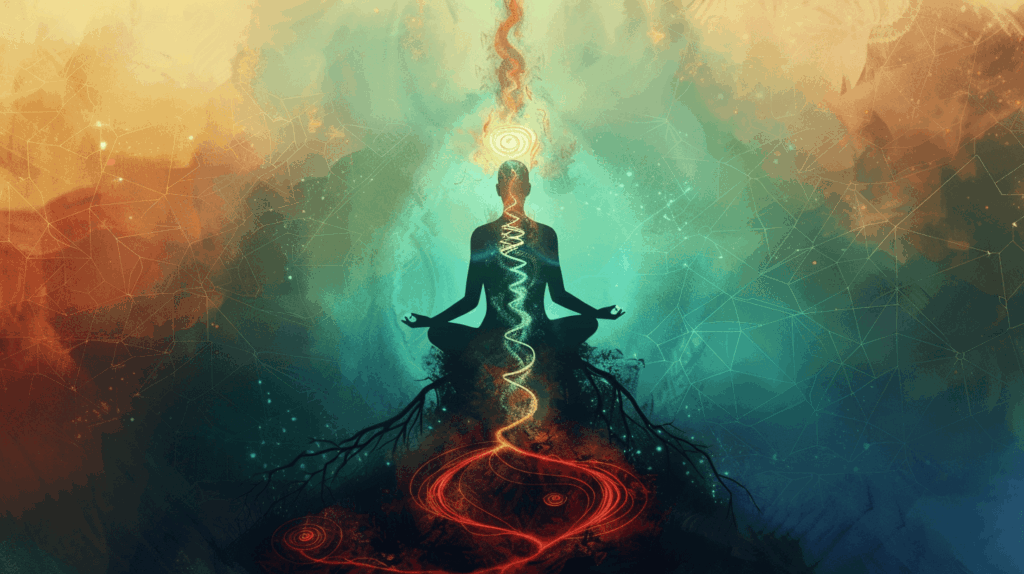
When Kundalini Feels Like Too Much: The Nervous System Connection Most Guides Miss
Why Capacity Changes Everything — And What to Do When You're Overwhelmed
When Kundalini Awakening Doesn't Feel Like Bliss
If your kundalini nervous system experience feels nothing like the bliss the books describe, you're not alone. Instead, the energy feels like too much — anxious, overwhelming, keeping you awake at 3am wondering if something is wrong with you. You read the standard kundalini guides and thought, "This isn't what they described."
However, you're not broken. You're not doing it wrong. And there's a reason this is happening.
Here's what most guides don't tell you: Kundalini awakening is as much a nervous system event as a spiritual one. Therefore, the difference between awakening that feels expansive and awakening that feels like crisis often comes down to one thing — the capacity of your nervous system to hold the energy moving through it.
This guide is specifically for you if you're mid-process and struggling, if the intensity feels unmanageable, or if you simply want to understand the kundalini nervous system dimension that most teachings leave out.
If you're looking for a foundational overview of kundalini — what it is, how it awakens, traditional practices — my Kundalini Awakening Guide covers that ground. Here, we're going deeper into why this can feel so hard, and what actually helps.

What I've Learned From My Own Awakenings
Over the years, I've experienced multiple kundalini awakenings. Some were intense and dramatic; others were subtler, quieter movements of energy. Each one varied in intensity, duration, and character.
What I've come to understand is that kundalini isn't necessarily a one-time event — once the energy has awakened, it tends to move again. And again. As a result, it becomes an ongoing relationship rather than a single breakthrough moment.
Notably, none of mine were forced. Some arose completely spontaneously; others were supported by plant medicine. I've come to believe that this energy doesn't need to be pushed — it often moves on its own when conditions are right. That said, if you feel called to actively facilitate the process, practices like breath holds and root locks can help.
The Heart of What I've Learned About the Kundalini Nervous System
The same energy can feel completely different depending on what my nervous system can hold in that moment. When there's capacity, the energy rises and it's extraordinary — expansive, illuminating, alive. However, when there's constriction, that same energy gets trapped, and what could be expansion becomes pressure, overwhelm, too much. The kundalini itself isn't different. My system's readiness is what changes everything.
The Kundalini Nervous System Connection: What Most Teachings Miss
Interestingly, the ancient yogic frameworks and modern neuroscience are describing the same phenomenon from different angles. As a result, the chakras that kundalini travels through aren't separate from your nervous system — they're intimately connected to it.
The Vagus Nerve and the Serpent Path
Specifically, the vagus nerve — the longest nerve in your body — runs from your brainstem through your chest and into your abdomen. Notably, it follows a remarkably similar path to kundalini's described journey. As a result, some researchers and practitioners have noted that what the ancient yogis called the "sleeping serpent" may correspond to dormant potential within the vagal system.
According to Stephen Porges' polyvagal theory, the vagus nerve has different branches that correspond to different states:
- Dorsal vagal (shutdown, freeze, collapse) — corresponds to the lower chakras and the brahma granthi, the first energetic knot
- Sympathetic (fight or flight, mobilization) — corresponds to the middle chakras and the vishnu granthi
- Ventral vagal (social engagement, safety, connection) — corresponds to the upper chakras and the rudra granthi
Therefore, when we talk about "blocked" chakras, we're also talking about places where your nervous system has constricted — often in response to unprocessed experience or trauma. Similarly, the traditional yogic concept of granthis (the energetic knots that block kundalini's rise) may represent the places where your nervous system holds its most protected patterns.
This isn't just interesting theory. It's practically useful. Because if kundalini awakening is partly a nervous system event, then nervous system regulation tools can help you navigate it.
Why Your Kundalini Nervous System Capacity Determines Everything
Think of your nervous system like a riverbed. When water flows through a wide, clear channel, it moves smoothly. However, when it encounters narrowing, debris, or blockages, pressure builds.
Similarly, kundalini energy works the same way.
When the Container Can't Hold the Energy
When kundalini rises through a system that has unprocessed trauma stored in it, chronic dysregulation, limited tools for down-regulation, or blocked energy centers — the experience can feel destabilizing, frightening, or even crisis-inducing. The energy isn't bad; there's simply nowhere for it to go.
When the Container Has Capacity
In contrast, when kundalini rises through a system that has been prepared through gradual capacity-building, has tools for nervous system regulation, has cleared major blockages, and has support and understanding of the process — the same energy can feel transformative in all the ways the traditions describe: expansive, illuminating, profoundly healing.
The energy isn't different. The container is.
This is actually good news. Because while you can't direct kundalini once it's moving, you can work with your nervous system. You can build capacity. You can develop regulation tools. You can clear blockages over time. Ultimately, the container can grow.
When Kundalini Feels Like Too Much: What's Actually Happening
If you're experiencing kundalini as overwhelming rather than expansive, here's what might be happening in your system:
Common Experiences of Overwhelm
- Nervous system flooding: Too much energy moving through channels that don't have capacity for it
- Trapped energy: Kundalini hitting blockages and creating pressure rather than flow
- Emotional surfacing: Old material coming up faster than you can process it
- Hyperactivation: Stuck in sympathetic (fight/flight) with no way to down-regulate
- Disorientation: Your usual sense of reality disrupted without a stable ground
- Physical symptoms: Sleep disruption, appetite changes, strange sensations, exhaustion
- Anxiety or fear: Especially if you don't understand what's happening
This Isn't Failure
Importantly, these experiences aren't signs that you're doing something wrong or that something is broken. Instead, they're signs that your kundalini nervous system needs support — specifically, regulation tools and time to integrate.
Often, the instinct when kundalini feels like too much is to push through, spiritualize the difficulty, or try to force the energy to move. However, this usually makes things worse. What actually helps is the opposite: slowing down, grounding, regulating, and giving your system what it needs to expand its capacity.
Remember
The energy isn't going anywhere. It can wait while you build the container to hold it.
Kundalini as Diagnostic: What Gets Stuck Shows You Where to Work
Here's something I've noticed in my own experience: when kundalini energy gets stuck somewhere in its rise — when it can't flow through — the material connected to that blockage often surfaces in the days or weeks that follow.
In other words, the energy seems to activate whatever is held in that constricted place, even when it can't move through it.
This suggests that kundalini isn't just a spiritual experience happening to you. It's intelligent. It's showing you where the work is.
What Different Blockages Might Reveal
- Lower chakras (root, sacral): Issues around safety, survival, belonging, sexuality, creative expression, or your relationship with your body
- Solar plexus: Power dynamics, self-worth, autonomy, boundaries, or how you move through the world
- Heart: Grief, love wounds, issues around giving and receiving, vulnerability, or connection
- Throat: Unexpressed truth, communication patterns, fear of being seen or heard, or creative blocks
- Third eye and crown: Mental patterns, rigid beliefs, spiritual concepts, identity structures, or disconnection from intuition
Consequently, rather than seeing blocked energy as failure, you can see it as information. The places where kundalini gets stuck are invitations — places where your attention and your healing work are needed.
Ultimately, the energy will move when the pathway is clear. Your job isn't to force it — it's to tend to what's blocking it.
Kundalini Nervous System Regulation Tools for Overwhelm
When kundalini energy feels like too much, these practices can help your system regulate. Importantly, they're not about stopping the process — instead, they're about giving your nervous system the support it needs to process and hold what's moving through.
Grounding Practices
Because kundalini energy moves upward, when you're overwhelmed, you need to balance with downward, grounding energy.
- Feet on earth: Stand barefoot on grass, soil, or sand. Let the earth absorb excess energy.
- Body awareness: Feel the weight of your body, the places where you contact the ground or chair. Let yourself be heavy.
- Cold water: Splash cold water on your face or hands. This activates the dive reflex and shifts your nervous system state quickly.
- Nature contact: Trees, water, earth — let the slower rhythms of nature help regulate your system.
- Eat grounding foods: Root vegetables, protein, warm cooked foods. Avoid stimulants.
Breathing Practices for Down-Regulation
Your breath is one of the fastest ways to shift your nervous system state.
- Extended exhale: Breathe in for 4 counts, out for 6-8 counts. The longer exhale activates the parasympathetic nervous system.
- Physiological sigh: Double inhale through the nose (one full breath, then a small additional sip), followed by a long exhale through the mouth. This is your nervous system's natural reset.
- Slow, gentle breathing: Simply slowing your breath — without forcing or controlling — can help regulate an activated system.
Important Note
Avoid activating breath practices (breath of fire, rapid breathing, long breath holds) when you're already overwhelmed. These add more energy to a system that's already flooded.
Orienting and Presence
These practices tell your nervous system that you're safe, here, now.
- Look around slowly: Let your eyes move around your environment, resting on objects. This activates the ventral vagal (safety) system.
- Name what you see: "I see a blue wall, I see a window, I see a tree." This engages your thinking brain and creates presence.
- Touch something textured: A rough stone, soft fabric, cool metal — sensory input that anchors you in the present moment.
- Feel your edges: Notice where your body ends and the world begins. You are contained. You have boundaries.
Movement
- Shake: Literally shake your body — arms, legs, whole body. This helps discharge excess energy. Animals do this naturally after stress.
- Walk: Bilateral movement (alternating left-right-left-right) is regulating for the nervous system.
- Gentle yoga: Grounding poses like child's pose, legs up the wall, or seated forward folds. Avoid intense or heating practices.
Co-Regulation
Your nervous system is designed to regulate in connection with others.
- Safe presence: Being with someone whose nervous system is regulated can help regulate yours.
- Soft eye contact: Warm, gentle eye contact with a safe person activates the social engagement system.
- Touch: Holding hands, a hug, or just sitting close to someone who feels safe.
- Voice: Hearing a calm, warm human voice — even on the phone — can be regulating.
Building Kundalini Nervous System Capacity Over Time
Regulation tools help in the moment. However, the longer-term work involves building your nervous system's capacity — expanding the container so it can hold more energy without flooding.
This Takes Time
First, understand that capacity isn't built overnight. Instead, it develops through consistent, patient practice over months and years. There's no shortcut, and trying to rush it usually backfires.
What Builds Capacity
- Regular nervous system regulation practice: Daily attention to your nervous system state and regular use of regulation tools, not just when you're overwhelmed
- Gradual exposure: Gently expanding your window of tolerance by working with activation in small doses, then returning to regulation
- Processing stored material: Working with the emotions, memories, and patterns that constrict your pathways
- Trauma work: If you have significant trauma, working with a skilled practitioner to process and release what's held
- Somatic practices: Yoga, breathwork, bodywork — practices that help clear the physical channels
- Rest: Your nervous system integrates during rest. Therefore, chronic sleep deprivation or constant activity works against capacity-building.
- Safety: Capacity builds when your system feels fundamentally safe. Consequently, chronic stress or unsafe environments make expansion difficult.
The Paradox of Trying
Interestingly, there's a paradox here: you can't force capacity to grow, but you can create conditions for it. Similarly, you can't make kundalini move through blockages, but you can tend to what's blocking it.
Ultimately, the work is less about doing and more about allowing — allowing your system to expand at its own pace, allowing material to surface and process, allowing the energy to move when it's ready.
When to Seek Support for Your Kundalini Nervous System Experience
You don't have to navigate this alone. In fact, trying to navigate intense kundalini experiences without support can make things harder than they need to be.
Consider Seeking Support If:
- The overwhelm isn't responding to self-regulation practices
- You're having difficulty functioning in daily life
- You're experiencing severe anxiety, depression, or dissociation
- You're having thoughts of self-harm
- You feel like you're "losing your mind" or losing touch with reality
- Physical symptoms are severe or concerning
- You simply want guidance and don't want to do this alone
What Kind of Support
Kundalini-informed practitioners: Look for someone who understands both the spiritual and physiological dimensions of what you're experiencing. This might include a somatic therapist, energy worker, breathwork facilitator, or spiritual guide with kundalini experience.
Mental health support: If symptoms are severe, a therapist or psychiatrist can help — ideally one who is open to spiritual experiences and won't simply pathologize what you're going through. Additionally, "spiritual emergence" frameworks can be helpful here.
Medical evaluation: Some kundalini symptoms can overlap with medical conditions. Therefore, if you're experiencing severe physical symptoms, it's worth ruling out other causes.
Community: Finally, others who have been through this process can offer invaluable understanding and support. You're not as alone as you might feel.
Your Next Steps
If you're navigating kundalini awakening and it's feeling like too much, I'm here to support you.
Terrain Session
See where the energy is getting stuck and what your system needs to hold more. Map the blockages, understand what's resourced, and get clear on your next steps.
Learn More →Somatic Breathwork
Breathwork can be both activating and regulating — what matters is matching the practice to your current capacity. We work with where you actually are, not where you think you should be.
Book Session →More Resources
For a foundational overview of kundalini awakening — what it is, the traditional framework, benefits, and preparation practices — see my Kundalini Awakening Guide.
To understand nervous system states and why regulation matters, visit The Map.
References and Further Reading
Nervous System and Polyvagal Perspective
- Stephen Porges — Polyvagal Theory and vagus nerve research
- Deb Dana — The Polyvagal Theory in Therapy
- Peter Levine — Somatic Experiencing and trauma resolution
Kundalini Resources
- Bonnie Greenwell — The Kundalini Guide
- Swami Sivananda Radha — Kundalini Yoga for the West
- Spiritual Emergence Network — support for those in spiritual crisis
Support This Work
If you found value in this guide, you can support the creation of more free resources:
Bookmark This
Save this for when the energy feels like too much again. You'll want it at 3am.
If this guide helped you feel less alone in your experience, I'd love to hear from you. And if you know someone struggling with an intense kundalini process, please share it with them. This work is too important — and too often misunderstood — to navigate without support.








Leave a Reply
Want to join the discussion?Feel free to contribute!