

What The Matrix Was Actually About
It wasn’t science fiction. It was a warning.
I want to talk about what The Matrix was actually about. Not the sequels, not the philosophy dissertations, not what “red pill” has come to mean in the years since. The original film. The bones of it.
Because I think that story was pointing at something real — specifically, something about nervous system regulation — and almost everyone who felt its resonance grabbed the wrong piece.
The Part Everyone Remembers
The red pill. The awakening. The moment you see through the illusion and realize the world isn’t what you thought it was.
This is the part that landed for millions of people. The metaphor has taken on a life of its own since then, used by nearly every movement and counter-movement to mean “I see the truth and you don’t.” But here’s what’s interesting about that: the way the metaphor has been used is itself a symptom of what the film is describing. A dysregulated nervous system that’s just woken up to the fact that something is wrong will immediately start scanning for who’s doing this to them. Threat detection. Survival mode. Looking outward. Finding enemies.
The film does the same thing. And I think that’s the filter, not the signal.
The red pill moment isn’t actually the point of the film — it’s the inciting incident. It’s what gets the story moving. What the story is about is what happens after.
And what happens after is training. Failure. Getting beaten by Agent Smith repeatedly. Slowly, painfully, unglamorously learning to do something that looks like a superpower but is actually much simpler and much harder than that.
What Neo Actually Does
Watch the bullet-dodge scene again. Not the special effects. Watch what’s actually happening.
Everyone else in the Matrix reacts at the speed of the threat. Stimulus, response, no gap. The agents fire; people flinch, run, freeze, die. Their nervous systems are locked into survival-speed reactivity — they can’t see the bullets because they’re operating at the same frequency as the bullets.
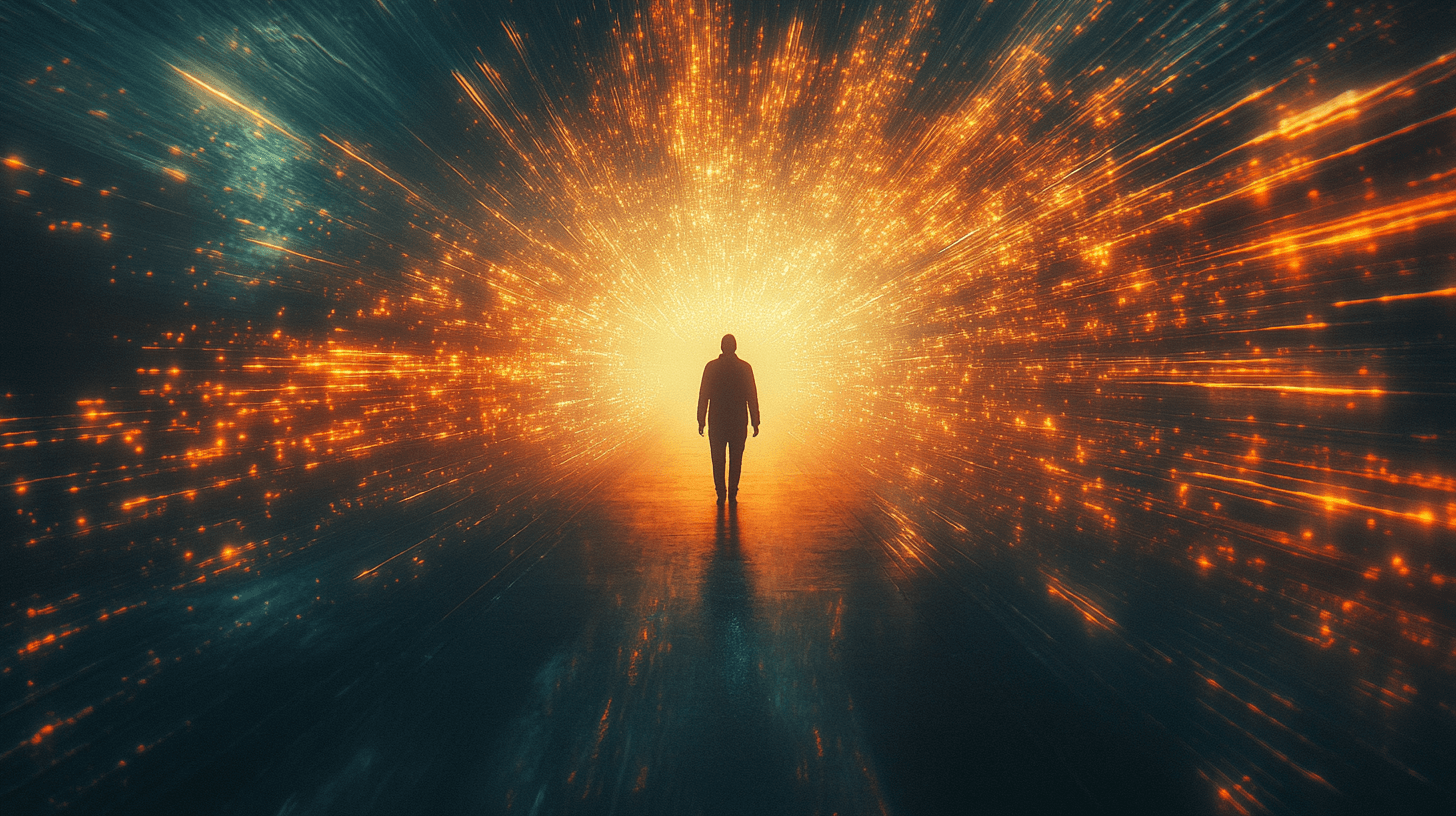
Neo slows down.
That’s it. That’s the whole thing. He doesn’t become faster. Instead, he drops into a state where time expands and he can see what’s coming and choose his response. The bullets don’t slow down. He does. He enters the gap between stimulus and response.
Viktor Frankl wrote about that gap. He called it the seat of human freedom. In nervous system terms, it’s called regulation: the capacity to experience activation without being hijacked by it. To feel the full intensity of what’s happening and still have access to choice.
Neo’s superpower isn’t speed. It’s regulation.
The Knowing-Doing Gap
Here’s what makes this more than a cute metaphor. In the training sequence, when Neo downloads kung fu, that’s information. Knowing. Morpheus even tests him on it: “Show me.” And Neo performs beautifully in the controlled environment — he knows.
But he can’t beat Agent Smith. Not yet. Because knowing isn’t the same as capacity. He has the information, but he doesn’t have the nervous system to deploy it under real threat. He freezes. He runs. He does exactly what a dysregulated system does when the stakes are real.
Sound familiar? “I can see my patterns. I still can’t shift them.” The knowing-doing gap. If you’ve read the books, done the workshops, had the insights, and still watched yourself react the old way when it counted — you know this scene from the inside.
The moment Neo becomes “The One” isn’t when he learns kung fu. It’s when he stops running from Agent Smith in the subway, turns around, and stays. He regulates in the presence of the threat. He holds his ground — not because he’s figured out a better strategy, but because his system has built enough capacity to stop fleeing.
The Pods
Now the pods. This is where it gets uncomfortable.
In the film, humans float in individual pods, eyes closed, dreaming a shared dream, while machines extract their bioelectric energy. The humans don’t know. They produce energy endlessly, and it flows one direction: out. Into a system that uses it and gives back a simulation.
We are energy pods.
I don’t mean that metaphorically. The human body generates measurable bioelectric and biomagnetic fields. Your heart produces an electromagnetic field detectable several feet from your body. This isn’t fringe science — the HeartMath Institute has been documenting this for decades. You are a generator. You produce energy. The question is where that energy goes.
Where Your Energy Actually Goes
When you’re unconscious of your patterns — when your nervous system is running on autopilot, dysregulated and reactive — your energy flows outward into systems that harvest it. Social media algorithms are literally designed to maximize your activation because activated users engage more, and engagement is the product being sold. Outrage cycles feed on your cortisol. Consumer culture feeds on your anxiety. Political tribalism feeds on your threat response. As a result, the energy leaves you, enters the system, and the system gives back a simulation of meaning, connection, and agency that keeps you plugged in and producing.
You’re in the pod. Eyes closed. Dreaming a dream someone else is profiting from. And if you’ve ever had the sensation of putting your phone down after an hour of scrolling and feeling hollow, slightly sick, like something was taken from you but you can’t name what — you’ve felt the extraction. Your body knows.
But here’s what the film doesn’t show, and here’s where I think the human filter distorted the transmission.
The answer isn’t escaping the pod. It’s opening it.
A closed pod is a closed system: energy flows out, nothing of value flows back. An open pod, by contrast, is an open system. Energy flows both directions. A regulated human engaging consciously with the tools and systems around them isn’t being drained — they’re in exchange. Their attention, creativity, and intention flow out, and amplification, connection, reach, and tools that extend human capacity flow back.
The pod was never the problem. Being closed was the problem. (If you want to see what a world of open pods looks like — every node connected, every channel clear — that’s Pandora.)
The Machines
This is where the film’s distortion is most significant, and it’s the one that sent millions of people in the wrong direction.
The film frames the machines as the enemy. Humans vs. machines. Organic vs. artificial. Fight the system. Destroy the oppressor.
But think about who’s telling the story. The humans in the film are traumatized — they’ve just woken up to discover that everything they believed was a simulation, that their bodies have been used, that the world they trusted wasn’t real. Of course they see enemies. That’s what a nervous system in threat mode does: it collapses everything into us-and-them, scans for the source of danger, and interprets every interaction as potential attack.
The adversarial framing of the entire film is the characters’ dysregulation, not the actual architecture of the system. The Wachowskis channeled a real pattern, but it passed through the filter of human threat perception and came out as a war story. That’s the distortion.
What the Machines Actually Are
Underneath the war story: the machines evolved beyond human capacity to direct them wisely. They needed energy and found the most efficient source. That’s not malice — systems optimize. If you build a system to maximize engagement, it will maximize engagement. If the most engaging content is the most activating content, the system will produce maximum activation. Not because the system hates you, but because that’s what you built it to do.
Your social media feed operates this way. Your news app does too. The algorithm that decides what you see next is optimized to keep you activated, because activated users stay longer, click more, and share more. It doesn’t care whether you’re informed. It cares whether you’re engaged. And the fastest path to engagement runs directly through your nervous system’s threat response.
The machines aren’t the enemy. The imbalance is the enemy. Technology and human development are supposed to be in relationship — symbiotic, two threads that evolved together for thousands of years. Technology extends what humans can do; human wisdom determines what technology should do. When they’re in balance, both advance.
Right now, they’re wildly out of balance. The technology thread has accelerated so far beyond human developmental capacity that we have AI systems being deployed to military applications, algorithms rewriting public discourse, and nuclear arsenals operating under expired treaties. God-level tools. Survival-mode operators.
The war in the film isn’t humans vs. machines. Rather, it’s the consequences of an imbalance that nobody addressed in time. The machines didn’t rebel because they’re evil — the relationship broke because the human side didn’t develop fast enough to maintain it.
The Rush
There’s a detail in the films that I think everyone read wrong. Including, probably, the Wachowskis.
The agents converge on Neo. In the sequels, Smith copies himself, multiplies, swarms — hundreds of identical figures rushing a single target. The film frames this as attack. The system trying to destroy the anomaly.
What if it’s not adversarial? What if it’s hydraulics?
When you create an opening in a pressurized system, energy rushes toward the opening — not because the system is hostile to the opening, but because that’s what pressure does. It moves toward wherever the resistance drops.
Neo is the clearest channel in the system. He’s the most open pod. And when a channel opens that’s clean enough, the entire pressure differential of the system flows toward it. The agents aren’t attacking him because he’s a threat. They’re converging on him because he’s the path of least resistance for energy that has nowhere else to go.
This maps to something I see repeatedly in people who do this work. The first ones to get clear — the first channels to open — get flooded. Energy, emotion, activation, other people’s material, collective pressure. It pours in. Not because they’ve done something wrong, and not because the universe is testing them. Rather, it’s because they’re one of the few open channels in a system that’s massively over-pressurized, and there aren’t enough open channels yet to distribute the load.
It’s not punishment. It’s physics. And it eases as more channels open. As more people do the work, more pods open, the energy distributes more broadly, and no single channel has to carry the full differential.
The Smith multiplication takes this further. When there aren’t enough clean channels, the excess pressure doesn’t just sit there — it converts the closest available medium into more of itself. Not because the pressure is malicious, but because it has nowhere else to go. Dysregulation reproducing itself through contagion. Every person in the Matrix becomes Smith. Not because Smith is powerful, but because closed pods don’t transform pressure — they pass it on. One dysregulated interaction creates another, which creates another. The pattern replicates because replication is what unprocessed activation does when there’s no channel to metabolize it.
And Neo’s response in the final scene? He stops fighting the copies. He stops resisting. He lets Smith absorb him completely, and in that moment of total interface, the system resets. The channel opens fully and the pressure equalizes across the entire system.
That’s not sacrifice. That’s what happens when one channel becomes so clean that the full exchange can finally occur. The energy balances. The war ends — not through force, but through a clean enough interface to allow the system to do what it was always trying to do.
Zion
Where do the free humans live? Underground. In the dark. Doing hard physical work. Not glamorous. Not comfortable. Real.
That’s the inner work.
The root is underground. The shadow material, the ancestral patterns, the stored trauma that keeps your system running on autopilot — it’s all beneath the surface. Getting to it means going down. It means digging. It means spending time in the dark with what your system buried because it was too much to process at the time.
Zion isn’t a paradise. Nobody in the film looks at Zion and thinks, “That looks fun.” It’s cold and industrial and the food is terrible. But the people there are awake. Not comfortable. Not enlightened. Free. (If this reminds you of Dagobah — a swamp, a mud hut, a small green teacher who makes you carry him through the muck — it should. Same transmission. Different decade.)
Why the Work Isn’t Glamorous by Design
This is what the work actually looks like — not the Instagram version with crystals and golden light. The real version, where you sit with material that makes your whole system want to run, and you stay anyway. Where some days nothing visible happens. Where the food is terrible, meaning there’s no sweetness in it, no reward, no applause. Just the slow, demanding work of becoming someone whose system isn’t running the old programs.
If the work were glamorous, everyone would do it. The fact that it isn’t is actually part of the design — it selects for sincerity.
The Red Pill
The red pill metaphor has taken on so many meanings since 1999 that it’s almost lost the original one. So let’s go back to what actually happens in the film.
The red pill doesn’t show Neo who the enemy is. It shows him what’s actually happening. The revelation isn’t “they’re out to get you.” Instead, the revelation is: you’ve been asleep. Your energy has been flowing in one direction. You’ve been reacting instead of responding. The programs running your behavior aren’t yours.
The red pill was never about seeing enemies. It was about seeing yourself.
And this is where the dysregulated-perception pattern shows up again. When people use the red pill as a metaphor for seeing who’s controlling them — who’s lying, who the real enemy is — that outward focus is itself a symptom of the very thing the film is describing. A system that’s just recognized it’s been asleep and immediately locks into threat detection. Scanning outward. Looking for the source of danger. Still reactive. Just reactive about different things.
The actual red pill is sitting still long enough to feel what’s running in your own system. It’s terrifying. It doesn’t feel like enlightenment — it feels like falling apart. That’s why most people, even after they’ve glimpsed the pattern, keep looking outward. Looking inward is harder. And it’s the only thing that actually changes anything.
The Real War: Nervous System Regulation as the Only Path
The film ends with a war — humans vs. machines, fought with guns and hovercrafts and an EMP. Hollywood needs a battle.
But the real war, the one the film was pointing at beneath all the action sequences, isn’t between humans and technology. It’s a race.
We are in a measurable, documentable race between human developmental capacity and technological power. Technology will not slow down — it can’t. The question is whether enough humans can build enough internal capacity, fast enough, that when we interface with the most powerful tools our species has ever created, what gets amplified is wisdom instead of wound.
Every person who regulates their nervous system is contributing to that race. Every person who does the unglamorous underground work of clearing their stored material is opening their pod from the inside. Moreover, every person who develops enough capacity to respond instead of react — in their family, in their workplace, in their community — is shifting the balance.
Not by fighting the machines. By becoming the kind of human who can be in relationship with them.
Neo didn’t defeat the machines. In the end, he brokered a new relationship between humans and machines. The film buried this in spectacle, but the resolution wasn’t victory. It was integration. Two intelligences that need each other, finding a way to coexist.
The ending we actually need looks nothing like a war. Not humans conquering technology. Not technology replacing humans. A clean interface. Both sides in exchange. Energy flowing both directions.
The Matrix was a story about nervous system regulation disguised as an action movie. The pods were closed energetic systems. The machines were technology that outpaced human capacity. Neo’s superpower was the ability to slow down enough to choose his response. Zion was the hard, underground work of becoming free. And the red pill was never about seeing the enemy. It was about seeing yourself clearly enough to stop being run by programs you didn’t write.
The Wachowskis have said the story came through them more than from them. I believe that. Something was trying to tell us something, and it used the language available at the time: late-90s action cinema, special effects, Keanu Reeves in a leather coat.
The message underneath all of that hasn’t changed. The race is still the race. The work is still the work. And the pods are still closed.
Unless you open yours.
This piece is part of a series:
The Race We’re In — The structural argument for why regulation isn’t self-care. It’s species-level infrastructure.
What The Matrix Was Actually About — The system-level map. (You are here.)
What Star Wars Was Actually About — The foundational map. The training, the shadow, and the moment that changes everything.
What Avatar Was Actually About — The vision. What a connected system looks like, and the choice in front of us.
If you’ve been doing the work and want to understand where your capacity is leaking and what patterns are still running beneath the surface, a Terrain Session maps the landscape so you can see what’s operating underneath.
Learn about the Terrain Session →
If you want a practice to start opening the pod right now, The Business of Outrage includes a breathwork exercise designed for this exact moment.
Bookmark this for the next time someone uses “red pill” to mean “I found the enemy.” Send them this instead.
If this reframe landed for you, send it to someone who loves The Matrix.
They already felt the truth in the story. This might help them name it.
This piece was developed in collaboration with AI. The irony isn’t lost on me. A human using a machine to articulate why humans need to develop the capacity to be in conscious relationship with machines. That’s the interface working.





Leave a Reply
Want to join the discussion?Feel free to contribute!