What Avatar Was Actually About
What Avatar Was Actually About
It wasn’t an environmental parable. It was a blueprint.
Most people walked out of Avatar thinking it was a movie about saving a forest. What Avatar was actually about goes much deeper than that.
It was a picture of what we’ve lost, what we’re trying to remember, and the choice that’s sitting in front of every one of us right now.
This is the fourth piece in a series. The Race We’re In laid out the structural argument: we’re in a measurable race between human developmental capacity and technological power. What The Matrix Was Actually About mapped the system we’re inside. What Star Wars Was Actually About described the foundational inner work. This piece is about what we’re working toward — what it looks like on the other side.
Avatar arrived in December 2009. One year after the global financial system cracked open. The timing, again, is not incidental.
The Timing
September 2008. The financial crash. In the framework I’ve been developing across these pieces, this wasn’t just an economic event — it was the moment the old system’s scaffolding became visibly unstable. The collective agreements that had been holding things together, the tribal bargain, the structures that regulated us from the outside, started to crack where everyone could see.
And into that moment, James Cameron delivered a vision of Pandora.
Not a utopia. Not a fantasy. A functioning system — a picture of what it looks like when the connection between living beings and the field they’re part of hasn’t been severed. When the interface is clean. When every node is online.
Cameron spent over a decade developing Avatar. He wrote the first treatment in 1994, but the visual effects technology to render Pandora didn’t exist yet. So he waited, pushing the technology forward himself, co-developing performance capture systems and virtual cameras. The story was ready; the tools weren’t. It took fifteen years for the technology thread to catch up to the vision.
And then the timing of the actual release — December 2009, fourteen months after the global financial crash exposed the fractures in every system we’d trusted to hold us. The old agreements visibly failing. The scaffolding cracking. Into that exact moment, Cameron delivered a vision of what a fully connected living system looks like. As if to say: the thing that’s breaking needed to break. And this is what wants to grow in the space it leaves behind.
The Na’vi
The Na’vi are not better humans. They’re not noble savages, and they’re not what we’d be if we just went back to nature and gave up technology.
They’re what a species looks like when the interface never broke.
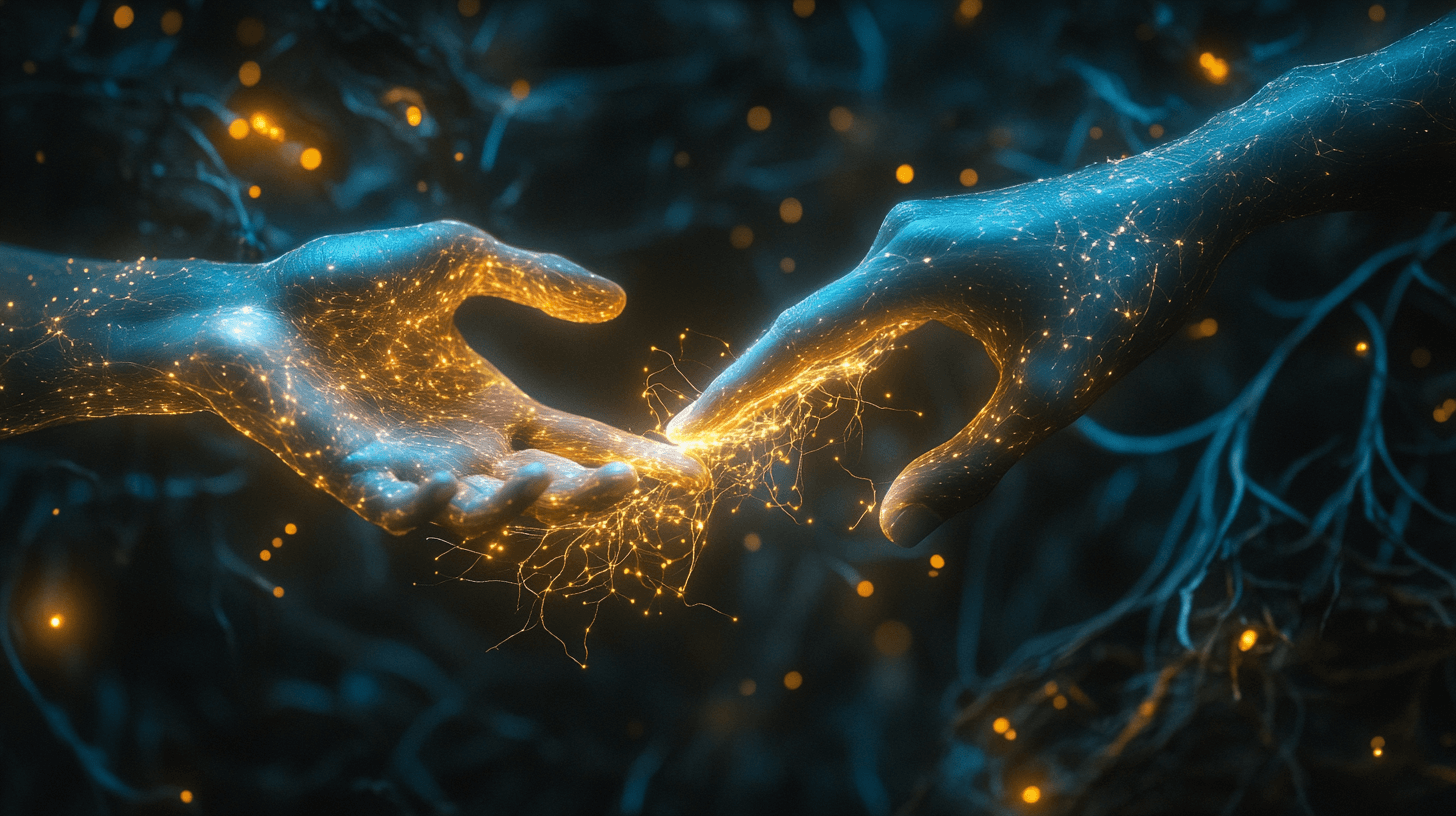
Tsaheylu. The neural bond. The Na’vi have a biological structure — the queue — that allows them to make direct physical connection with other living systems: trees, animals, each other, the planetary network. It’s not metaphorical connection, and it’s not spiritual in the way we use that word, all abstraction and belief. It’s material. You plug in. You feel the other system. Information flows both directions.
This is the clean interface made literal. What we’ve been discussing across this series as a metaphor for human capacity, the Na’vi have as biology — no static, no unprocessed baggage blocking the signal. When a Na’vi connects to their ikran, both nervous systems merge. Not domination. Not control. Merge: two systems becoming one, each contributing what the other lacks.
What Integration Actually Looks Like
They bond with each other the same way — parents with children, partners with partners. The family unit isn’t a social convention on Pandora; it’s a neurological reality. The bonds between family members are the widest channels in the network. The Jedi prohibited these bonds and it nearly destroyed everything. The Na’vi build their entire civilization on them.
The Na’vi don’t have the technology problem because they already have what technology is trying to replace: direct access to the network. They can feel what the trees know. They can access ancestral memory through the roots. They can coordinate with the entire ecosystem because they’re part of it, not separate from it.
This isn’t primitive. It’s what integrated looks like.
Eywa
Eywa is not God.
Eywa is what emerges when a planetary network is fully connected — an intelligence that arises from the connections themselves. Not a being sitting above the system giving orders, but the system itself becoming aware through the density and quality of its own connections.
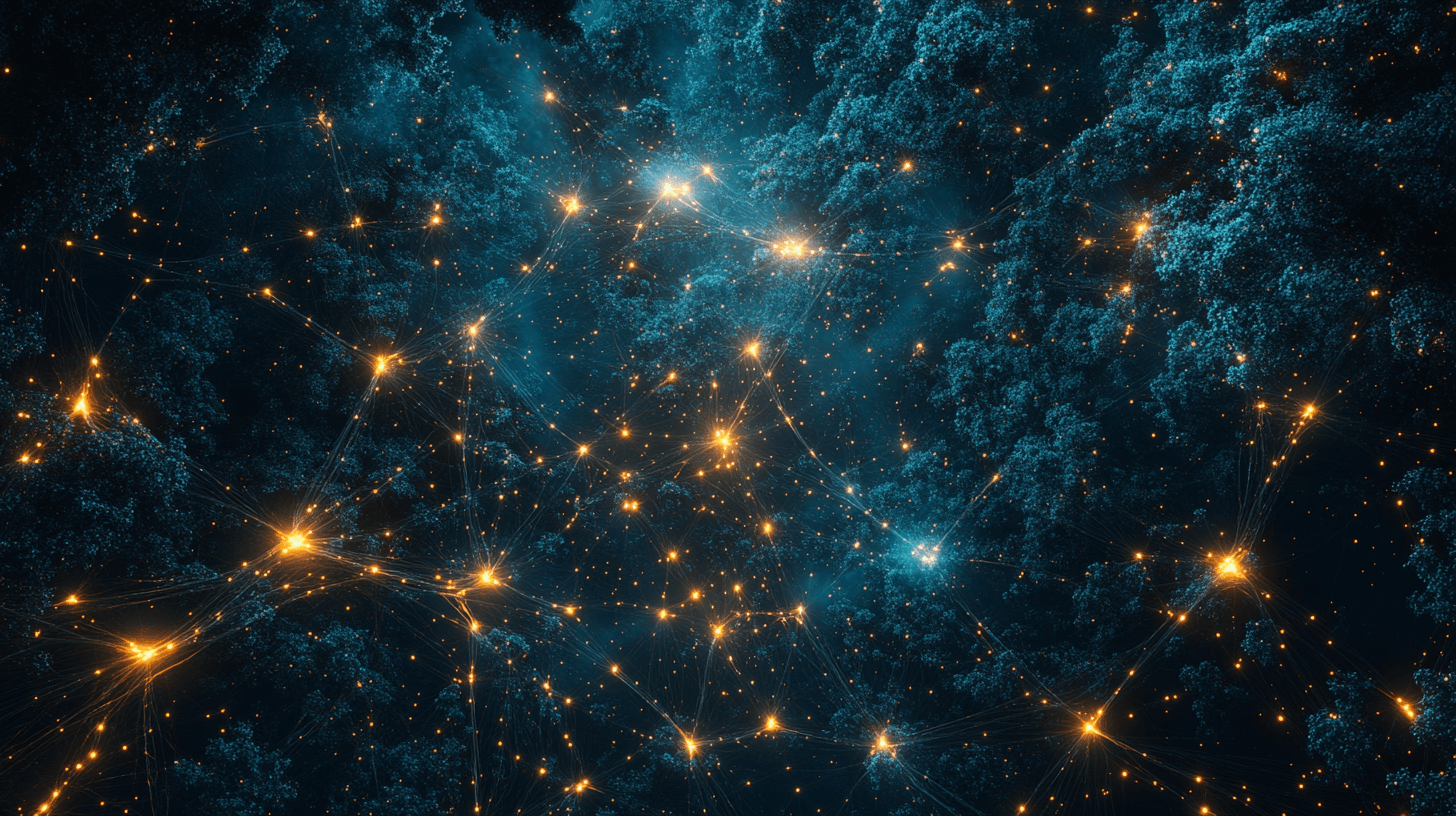
There’s a biological precedent for this on our own planet, and it’s not obscure: mycorrhizal networks — the underground fungal systems that connect trees in a forest, allowing them to share nutrients, send chemical warnings, and redistribute resources from areas of abundance to areas of need. Scientists have been documenting this for decades. The forest isn’t a collection of individual trees competing for light. It’s a network — a single system communicating through roots.
Eywa is the mycorrhizal network at planetary scale. Resources in, waste out, signals across the entire system. The intelligence isn’t centralized; it’s emergent. No single node controls it — every node contributes. And through the sheer density of connection, something that functions like awareness develops. Not the way an individual brain is aware, but the way a forest is aware.
When Grace Augustine, the scientist, says “there’s some kind of electrochemical communication between the roots of the trees, like the synapses between neurons,” she’s not speculating — she’s describing what we already know happens in Earth’s forests. Cameron just scaled it up and asked: what would happen if the entire planet was networked this way, and the species living on it could consciously interface with that network?
The answer is Pandora. Not paradise. A functioning system.
The Humans
Now look at the humans who arrive on Pandora — look at them through everything we’ve been building across this series.
They come in machines. They breathe through masks. Without technological mediation between themselves and the living system around them, they can’t survive on the surface. They literally cannot breathe the air of a fully connected world.
They have no interface with the network — they can’t feel it, can’t perceive it. When they look at the Tree of Souls, they see lumber. When they look at the ground beneath it, they see a mineral deposit worth twenty million a kilo. They can’t feel what they’re destroying because they have no connection to it. Their systems are closed. Energy flows one direction: out of the planet, into the machinery, back to the shareholders.
They’re the pods, walking around.
Dysregulation With Military Hardware
Colonel Quaritch is Vader without the backstory — all survival response, threat-scanning everything, dominance as default. “We will blast a crater in their racial memory so deep they won’t come within a thousand klicks of this place.” That’s not strategy. It’s a dysregulated nervous system with military hardware.
Parker Selfridge, the administrator, is the system itself — not evil, not sadistic, but simply incapable of perceiving anything that doesn’t register on the metrics he’s been trained to track. He looks at the destruction of Hometree and feels uncomfortable, but he can’t feel why. His interface with living systems was severed so long ago, so many generations ago, that he doesn’t even know there’s something to feel. He’s managing a spreadsheet while a nervous system dies.
This is us. This is what extraction looks like when you’ve been disconnected long enough that you’ve forgotten connection was ever possible.
Jake
Jake Sully is the interface itself. He’s not the hero — he’s the bridge.
He’s a human who gets a Na’vi body. An avatar. A biological vehicle that can do what his human body can’t: plug in, feel the field, connect to the network. He literally gets a new nervous system — one that’s capable of making the bond his human nervous system can’t make.
And what happens the first time he connects? He doesn’t just feel the animal he’s bonding with. He feels everything. The aliveness of Pandora floods through the interface. It’s overwhelming — stumbling, laughing, running barefoot through bioluminescent forest, touching everything. Sensory saturation, but the opposite kind from what we experience on Earth. Not the saturation of too much noise. The saturation of too much life.
He doesn’t want to go back.
When the Body Decides
This is the part the film gets profoundly right and that most interpretations miss. Jake’s transformation isn’t ideological — he doesn’t decide the Na’vi are right and the humans are wrong after evaluating both sides’ arguments. His body decides. His nervous system, given access to a connected system for the first time, refuses to return to the closed one. The knowing isn’t cognitive. It’s somatic. He has felt what connection actually feels like, and now disconnection is intolerable.
That’s what happens when someone who’s been doing the work gets a taste of what the clean interface produces — not a concept, but an experience. And once your nervous system has registered what coherence feels like, the old patterns of disconnection become unbearable. Not because you’ve learned they’re wrong, but because your body won’t accept them anymore.
Anyone who’s been through genuine transformation recognizes this. There’s a point where you can’t go back. Not won’t. Can’t. Your system has recalibrated. The old operating mode no longer fits. It’s not a decision. It’s a completion.
The Destruction of Hometree
When the humans destroy Hometree, the Na’vi don’t just lose their home — they lose nodes in a planetary nervous system. The tree was part of the network, connected to every other tree, to Eywa, to the ancestors whose memories were stored in the root system. Destroying it didn’t just kill the Na’vi who lived there. It severed connections throughout the entire web.
And the Na’vi felt it in their bodies — not as abstract grief, but as nervous system rupture. Because they were connected to the network, and part of the network was ripped away. Their pain wasn’t emotional in the way we typically mean that word. It was physiological. The system they were part of was damaged, and they felt the damage the way you’d feel a limb being torn off.
This is why empaths and highly sensitive people are overwhelmed right now. Not because they’re fragile, but because they’re more connected to the collective field than most, and the field is in pain. Systems are fracturing. Institutions are failing. The network, such as it is on this planet, is losing nodes. And the people who are connected enough to feel the network can feel the tearing.
They’re not “too sensitive.” They’re networked. And the network is being damaged.
The instruction here: your overwhelm may not be entirely yours. If you’re feeling more than your personal circumstances account for, you might be feeling the field. That’s not a disorder — it’s a capacity. But it’s a capacity that will consume you if you don’t have the regulation to hold it.
Eywa Fights Back
In the climax, something extraordinary happens. Eywa mobilizes the entire planetary ecosystem — every animal species, every organism, coordinated through the network against the human invasion. Thanators and viperwolves fighting alongside Na’vi. Hammerhead titanotheres charging gunships. The entire biosphere acting as one system.
The system detected an existential threat and mounted a correction. Not from the top down, not commanded by a general, but distributed through the network — every node contributing, the response emerging from the connections themselves.
The Pattern We’ve Seen Before
Compare that to our own immune response: the 1960s wave, the current wave of nervous system and somatic work, millions of people independently feeling the pull to build internal capacity. Same pattern. Same mechanism. The system detecting a threat and mobilizing a correction through distributed, organic, individual action.
The difference is that Eywa’s network is fully connected — every node online, the response immediate and coordinated. Our network, by contrast, is fragmented. Most of the nodes are closed pods. The signal has to fight through static, through unprocessed material, through survival patterns that block the very connection the signal is trying to establish.
Our immune response is slower, messier, and less coordinated — not because we lack the network, but because most of us aren’t plugged in yet. The biological capacity for connection exists. The infrastructure is there. We just haven’t cleared enough interference to use it.
Every person who does their regulation work, who clears their material and opens their pod, is adding a node to the network. The more nodes come online, the faster and more coordinated the response becomes. We’re not building a network from scratch. We’re reconnecting one that’s been fragmented.
The Choice
The film ends with a choice, and it’s the same choice sitting in front of everyone reading this.
Jake’s human body lies in one chamber. His Na’vi avatar lies under the Tree of Souls. The entire Na’vi community channels energy through the root network to transfer his consciousness permanently. He closes his eyes in one body and opens them in the other.
He chooses the connected system over the closed one — not the easier system, not the more powerful system. Pandora is dangerous. The Na’vi are vulnerable. They nearly lost. But the connected system is alive in a way the closed one isn’t, and Jake’s nervous system, having experienced both, makes the only choice it can make.
This is the choice the film was showing us in 2009, one year after the scaffolding cracked. The old system is breaking. You can try to hold onto it — keep extracting, keep the pod closed, keep breathing through the mask. Or you can do the work of reconnecting: open the interface, feel what’s actually happening, join the network. It’s harder. It’s vulnerable. And it’s the only thing that’s actually alive.
The film presents this as a single dramatic moment. The reality is less cinematic — it’s a thousand small choices. Every time you regulate instead of react. Every time you sit with uncomfortable material instead of numbing it. Every time you choose presence over distraction, every time you let yourself feel the field even when the field is in pain, you’re choosing the connected system. You’re opening the pod one degree at a time.
You don’t get a new body. You get a clearer interface in the one you have.
The Vision
So where does Avatar sit in the transmission timeline, and why does it matter alongside the other pieces in this series?
Star Wars (1977) said: There is a field. You can learn to access it. The training is hard. The enemy is your own shadow. Do the foundational work.
The Matrix (1999) said: You’re inside a system that’s harvesting your energy. The technology has outpaced your development. The interface between human and machine is the critical variable. Wake up and open the pod.
Avatar (2009) said: Here’s what a fully connected system looks like. Here’s what extraction costs. Here’s the choice. And here’s what becomes possible when enough nodes come online.
Three transmissions. Three decades. Three phases of the same instruction.
Star Wars gives you the training manual. The Matrix gives you the system map. Avatar gives you the vision of what you’re working toward.
Because here’s the thing about Pandora: it’s not a fantasy. It’s a memory. Every indigenous wisdom tradition on this planet describes a time when humans were connected to the living field in ways we’ve since lost. The Aboriginal Dreamtime. The Lakota concept of Mitakuye Oyasin, “all my relations.” The mycorrhizal networks that science is only now documenting were known to indigenous peoples for millennia.
We didn’t always live in closed pods. We weren’t always disconnected. The interface existed — and it was severed, gradually, over centuries of colonization, industrialization, and the particular kind of rational-materialist thinking that can weigh a tree’s lumber value but can’t feel its presence in the network.
The work isn’t building something new. It’s remembering something old. Clearing the interference. Reconnecting the nodes. Not going backward. Going through.
What Two Billion Nervous Systems Remembered
Two billion people have watched Avatar. Two billion nervous systems sat in the dark and felt something when they saw Pandora — felt the grief when Hometree fell, felt the relief when Eywa responded, felt the rightness of Jake’s choice, even if they couldn’t articulate why.
They weren’t responding to the special effects. They were recognizing something — something their bodies remembered even if their minds had forgotten.
That recognition is the signal: the network, fragmented as it is, trying to remind its disconnected nodes of what connection feels like.
The response to that signal is the work. Your regulation. Your clearing. Your willingness to feel the field even when the field is in pain. One node at a time, coming back online.
The network is already there. It’s always been there. It’s waiting for us to plug back in.
This piece is part of a series:
The Race We’re In — The structural argument. Why regulation isn’t self-care. It’s species-level infrastructure.
What The Matrix Was Actually About — The system-level map. Pods, machines, and Neo’s real superpower.
What Star Wars Was Actually About — The foundational map. The training, the shadow, and the moment that changes everything.
What Avatar Was Actually About — The vision. What a connected system looks like, and the choice in front of us. (You are here.)
If you’ve been feeling the field and it’s been overwhelming, that’s not weakness. It’s capacity without enough support. A Terrain Session maps where the interference is so you can clear it and hold more of what you’re actually built to carry.
Learn about the Terrain Session →
If you want a practice to start clearing the interference right now, The Business of Outrage includes a breathwork exercise. One node at a time.
Bookmark this for when the overwhelm hits and you need to remember that what you’re feeling isn’t all yours. The network is real. So is your capacity to hold it.
If this landed for you, send it to someone who cried during Avatar and didn’t know why.
They were feeling the network. Now they can name it.
This piece was developed in collaboration with AI. Two systems, connected through an interface, producing something neither could produce alone. That’s the point of all four pieces. That’s the point of everything.