Ancestral Healing: Working With Inherited Patterns
In this piece
What ancestral healing is
Ancestral healing is the work of noticing what came down to us through our family line, and choosing what to do with it.
Some of it we’ll want to keep. Some of it we can set down. And some of it has lived with us so long that it’s ours now, to work over time.
Anyone who has tried to change a pattern has probably already done some ancestral work. Most of the patterns we carry were learned from the people who raised us, and they learned them from the people who raised them. Trace a pattern back far enough and we usually find family.
That’s why pattern work is so often ancestral work, whether we set out to do it or not.
How family patterns get handed down
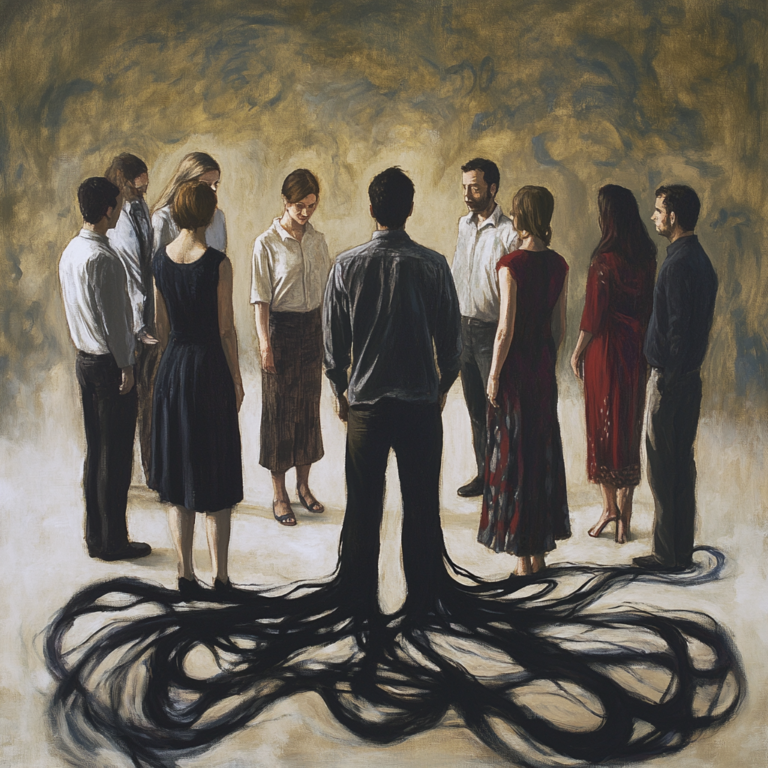
Most of what we carry from our families reaches us through how we were raised. Our parents raised us the way they were raised. Their parents did the same.
Take something as ordinary as eating fast. In some houses, dinner was a battlefield. Everyone ate quickly, kept their heads down, and got away from the table. And it was a battlefield for the parents too, when they were children. Nobody sat down and taught anyone to eat fast. It was just how the table worked, for two or three generations.
And now, we might notice we eat fast, even though the battlefield is gone.
We can change that without looking at anything. We can tell ourselves to slow down, put the fork down between bites, and try again tomorrow. But often that goes slowly, because the body still believes the table isn’t safe.
Or we can look at the pattern. We can see what was happening when it took hold, and what it was protecting us from. Then we can work with the body, so that the next time the old hurry rises at the table, we’re steady enough to stay with it, and slow down anyway.
The body gets a new experience: slowing down, and nothing bad happening. That’s how a pattern changes. The old feeling has to be present, and something new has to happen while it is. Repeated, the body updates what it expects.
Some of what we carry may come down through the body itself. Research on people who were in the womb during the Dutch Hunger Winter of 1944–45, a famine during the Second World War, found differences in how certain genes were marked about sixty years later. And all of us learn our first ways of being safe from the people who raised us, who learned theirs the same way.
Why it’s so hard to do it differently
Many of us have tried to do something differently and found it much harder than it should have been. There’s a reason. Changing a pattern takes more than deciding to.
- It takes capacity, enough room inside to feel the old feeling without being swept away by it. Without that room, the pattern runs before we can choose.
- It takes enough safety to slow down and look. A body that feels under threat doesn’t stop to reflect.
- It takes room beyond just getting by. When every day goes to survival, there’s nothing left over for looking at a pattern, let alone changing it.
- It takes support, someone beside us while we do it. Most of us learned our patterns in relationship, and we tend to change them in relationship too.
- And it takes knowing there’s another way at all. It’s hard to choose something we’ve never seen anyone do.
Now think about the people who raised us, and the people who raised them. Many of them simply didn’t have these available. They were often well-meaning, loving parents carrying their own wounds, doing what they could with what they had.
That doesn’t excuse the pain, or what came of it. But it can help lift the weight of blame, and of guilt.
How to trace a pattern back
To find where a pattern comes from, we start with something we’d like to change. Not our whole family history. One thing.
Then get curious about it:
- How present is it in your life right now?
- How far back can you trace it?
- What was happening around it when it started?
- Who else in your family, or among the people who raised you, knew this feeling?
Often the tracing leads back to childhood, then to our parents, and then to theirs. Many of our deepest patterns started somewhere along that line.
We don’t need to find answers right away. The noticing is the practice.
Is this mine? Yes and no
There’s a question I ask often in my work: is this mine?
It’s a way of sorting. When a feeling rises, or a reaction takes over, we pause and ask whether it belongs to us, or whether we picked it up from someone else. A friend’s anxiety. The tension in a room. A partner’s bad day.
With family, the answer can sound like this: I don’t want to do it that way. I’m going to find a different way.
Sometimes it really is that simple. We see it, we name it, and we put it down.
Some readers will know Mark Wolynn’s It Didn’t Start With You, and the idea of giving a pattern back to the relative it belongs to, saying, in effect, I’ll do it differently. Some of it really can be given back.
But if a pattern has lived with us for years, it has also shaped our nervous system, our habits, our relationships. That part is ours now.
So the answer to “is this mine?” is yes and no.
The part that isn’t mine, I can set down and do differently.
The part that has lived with me is mine to work.
How to work the part that’s ours
We work an inherited pattern the same way we work any pattern: with the nervous system on board.
Patterns are held in the survival parts of us, the parts that learned, early, how to stay safe. When a pattern is active, the body is often too revved up or too shut down to see it clearly. So first we build enough room inside to stay present with it. Then we can see it, navigate it, and integrate it.
This is slow work, and it’s meant to be. We touch a little of the old feeling, then come back to steady ground, then touch it again. Over time the pattern has more space around it, and we have more choice.
We don’t have to heal our families
Every pattern we work reaches back down the line. That comes with the work. It isn’t a duty.
We don’t have to set out to heal our families. Working our own pattern already reaches back.
Sometimes it’s one person doing it differently, once, where the family can see. It may not be welcomed. It still plants a seed.
And their reaction isn’t ours to fix. We offer the different way, and what they do with it is theirs.
For some of us, showing the new way to family isn’t wise yet, or isn’t wise at all. Capacity and right timing apply here too. Sometimes the different way gets lived in private first, or with chosen family, long before it’s shown at the dinner table. That counts.
Not everything handed down is heavy
Strength comes down the line too, and so does humor. Part of this work is noticing what we want to keep.
I wrote about finding that strength in my own line, through the women on my mother’s side, in Ancestral Lineage Healing: Seeing the Strength in Your Line.
And for the older ways of being in relationship with the ancestors, as guides and as people still finding their own healing, there’s Ancestors from a Shamanic Perspective.
When this is tender
Lineage can mean the family we know, or the one we don’t. It can mean the people who raised us, whoever they were.
No one has to turn toward anyone they don’t want to. And if grief comes up while reading this, it’s welcome.
A simple ancestral healing ritual
This is one we use in Sacred Circle, my weekly online gathering. It takes a few minutes.
Sit somewhere quiet and take a few slow breaths, letting the exhale be a little longer than the inhale.
Bring to mind one thing you carry that came down to you. A strength, a habit, a worry, a way of being.
Then ask it a few questions, and let your hands answer.
If it’s a gift, bring your hands to your heart. This one stays.
If it isn’t yours, open your hands, and on the exhale, let them move a little away from you. You’re handing it back.
If it has lived with you so long that it’s yours now, rest your hands on your belly. This one is yours to work, over time.
And if you’re not sure, trust that. Not sure is its own answer, in this moment.
It carries forward, too
The work that reaches back also carries forward, to our children, and to theirs.
For parents, this is where the guilt can come in. Many of us flog ourselves for not healing it all, or not healing it early enough, and for the ways our children were exposed to some of it.
In my experience, even fixing small things, in small ways, lets them know it’s okay to do things differently. That small thing keeps the healing moving down the line.
These patterns didn’t arrive in a single generation, and they rarely resolve in one.
Somewhere down the line, the same table might look like this. Someone is telling a long story about their day, and nobody hurries them. A child asks a question and gets a real answer. There’s an argument about something that doesn’t matter, and it ends in laughing. The plates empty slowly. When dinner is over, people stay where they are, still talking, because there’s nowhere else they’d rather be. Nobody at the table is braced.
Working with this
We could leave it where it is. That’s a real option, and most people take it. Nothing bad happens. The pattern keeps running the way it always has, at the table and everywhere else. It’s allowed.
For anyone who’d like company in this, there are a few ways in.
Sacred Circle
Meets every Sunday at 11 AM Eastern, online. We practice this kind of sorting together, with the nervous system first.
The Terrain Session
Maps the patterns we’re carrying, including the ones that came down the line, and gives a place to start.
The Joy of Becoming
A six-month program for working patterns over time, with support.
The ancestral healing series
- Ancestral Healing: Working With Inherited Patterns (this piece)
The pattern in us: tracing it back, sorting what’s ours, and working it with the nervous system on board. - Ancestral Lineage Healing: Seeing the Strength in Your Line
The people in the line, seen whole, and the strength that came down with them. - Ancestors from a Shamanic Perspective
The ancestors themselves: well and unwell ancestors, soul groups, and ways to honor them.
Sheila Rumble is the founder of Rowan Wellness in Waxhaw, North Carolina, where she offers Terrain Sessions, QHHT, breathwork, and the weekly Sacred Circle, online and near Charlotte.