
Separate Rooms, Same Root
Why I Built the Terrain Session
Wound patterns don’t announce themselves. They don’t arrive with labels. Instead, they start like this:
I was five years old, crying in the hallway before my report card came out.
Not because I’d done poorly. Because the time before, I’d gotten an “N” — needs improvement — for talking too much. And I’d gotten in trouble for it.
I don’t remember the trouble. I remember the dread.
By grade school, the rule was established: anything below an A meant grounding until the next report card. (Later, a B+ in an AP class was enough.) By fifth grade, the pattern was entrenched enough that I cheated on a spelling test I wasn’t prepared for — and got caught. A ten-year-old, so terrified of falling below the line that she’d rather risk getting caught cheating than risk a bad grade.
So I learned what my nervous system needed me to learn: your safety depends on being seen as competent. Anything less is dangerous.
I became the quiet one. The one who got it right. The one who performed well enough that nobody had reason to question me. I learned to hide within the “A.”
And that worked — until it didn’t.
Before We Go Further
I’m not telling this story to assign blame. I spent plenty of years doing that when I was younger, and it didn’t heal anything. By the time I could actually see the threads — really see them — the blame piece had fallen away. My parents carried their own burrs out of their own childhoods, and those burrs shaped how they parented. That’s not an excuse. It’s just what’s true. We all walk out of childhood carrying something. Every single one of us. Including the people who raised us.
A Note
Your wound patterns might not look like mine. Maybe yours weren’t about grades. Maybe they were about keeping the peace, or staying small, or being the easy one, or performing happiness in a house that couldn’t hold sadness. The specifics vary. The mechanism doesn’t. Something landed early, it had hooks, and it started catching.
How Wound Patterns Actually Work
Most people think of a wound as a single injury. Something happened, it hurt, and now you carry that hurt. Simple. Linear.
But often, that’s not how it works.
A wound — especially one inflicted early, before you have the capacity to make sense of it — is more like a burr. If you’ve ever walked through a field and come out with those prickly seed pods stuck to your clothes, you know what I mean. A burr doesn’t just sit where it lands. It has hooks. It catches on things. It snags whatever brushes past it.
A childhood wound does the same thing. It lands in one place — say, a five-year-old learning that her report card determines whether she’s safe — and then it starts catching. It catches on every subsequent experience that even resembles the original threat. It snags new material, new fears, new adaptive strategies. Over time, what started as one injury has gathered so much around it that you can barely see the original burr underneath.
Key Insight
What makes wound patterns so hard to work with: every piece of material the burr snagged looks like its own separate problem. Perfectionism looks like a problem. Difficulty trusting authority looks like a problem. Hyperindependence looks like a problem. Quietness looks like a problem. They are problems — but they’re not separate problems. They’re all caught on the same burr.
The Seed Inside the Wound
There’s one more thing about burrs, though — and I didn’t see this until much later.
A burr is a seed pod. That’s its entire biological purpose. It hooks onto things so it can travel — so it can be carried to new ground. And when it finally lands in fertile soil, when the conditions are right, it doesn’t just sit there. It cracks open. Something grows.
Wound patterns work the same way. They’re not just damage. Wrapped inside the pain, inside the hooks, inside all the material gathered over the years — there’s something alive. The sensitivity that came from hypervigilance becomes genuine perceptual depth. The self-reliance that grew from not being able to trust authority becomes real discernment. And the silence that started as self-protection becomes the capacity to listen — truly listen — in a way most people never develop.
The wound carries the seed of its own transformation. But only if it finds the right soil — a place where it can finally be seen whole, held without judgment, and allowed to open.
That’s not inspiration. That’s biology. And it’s what I’ve watched happen, in myself and in every person I’ve sat with in this work.
The Wound Patterns I Could Name But Couldn’t Connect
For decades, I could identify each of these patterns individually. I’d done the work. I’d done the plant medicine ceremonies. I’d done somatic work, breathwork, inner child work, parts work. I am not someone who has avoided looking at herself.
Yet I could describe, in articulate detail, each thread:
The perfectionism. I knew I held myself to impossible standards. I could trace it back to childhood, and I could name the cost — the exhaustion, the inability to rest, the constant low-grade anxiety that I’d missed something.
The authority resistance. I knew I had a thing about being told what to do. Specifically, I don’t respond well to directives that remove my choice. I’ve been told I’m stubborn, independent to a fault, unable to let others lead. One of my kids once told me that if there was a single defining word for me, it would be noncompliant. (They weren’t wrong.) I could name that pattern, too.
The hyperindependence. I ran my own verification process on nearly everything — every doctor’s recommendation, every expert opinion, every suggestion from someone who supposedly knew better. I couldn’t rest in someone else’s competence. The cost was enormous: the energy of never being able to put the notes down, never being able to just trust that someone else had it handled.
The silence. Somewhere along the way, I’d become the quiet one. Content to stay on the sidelines. Watching, assessing, rarely volunteering my voice unless I was certain it would be received well.
I could name every one of these wound patterns. I’d spent years in various forms of healing work examining each one. Each felt like a real insight when I reached it.
And still — I could not shift them. Not really. Not in the moments that mattered.
The Root Beneath the Wound Patterns
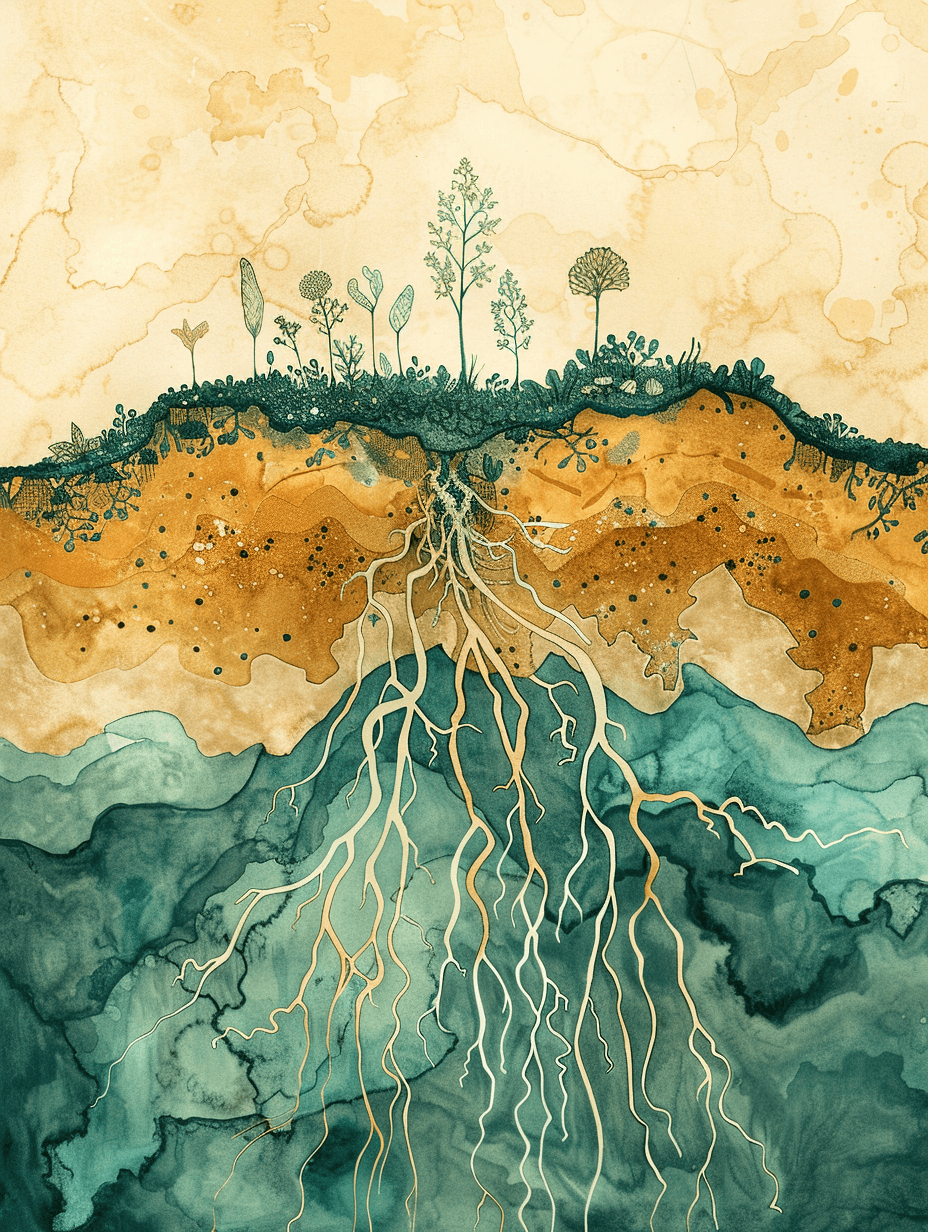
Here’s the thing about wounds that land early: they don’t just create one pattern. Instead, they create an architecture. A whole system of adaptive responses that are all serving the same hidden purpose — but because they show up in different areas of your life, you never see them as connected.
The perfectionism wasn’t about excellence. It was about making sure no one had grounds to act against me. I didn’t pursue A’s because I loved achievement — I pursued A’s because a B+ meant someone took something from me.
The silence wasn’t introversion. Rather, it was the removal of the thing that got me punished. I talked, I got marked down, so I stopped talking. Not because I had nothing to say — because saying it had become a liability. Expression turned into evidence that could be used against me.
The authority resistance wasn’t rebellion. It was the logical conclusion of a nervous system that learned: the people with power over me used that power based on their own limitations, not on accurate seeing. As a result, I built sovereign verification because the alternative was submitting to judgment that was never fair in the first place.
And the hyperindependence wasn’t strength. It was the tax. If your safety depends on never giving anyone grounds to declare you inadequate, then you can never rest in someone else’s competence. You have to run the parallel process. Always. Because the one time you don’t — that might be the time it costs you everything.
One burr. Four threads caught on it. Each one looking like its own problem.
And underneath all of them, the same root: my safety has never been unconditional.
The Layer I Couldn’t See
But there was something even deeper — and this is the part that took a structured process to surface, because I genuinely could not see it from inside.
I’m a leaver. When I’m done, I’m done. When someone consistently fails to meet the standard, something in me goes clean and cold and final. I don’t go back.
I knew this about myself. What I didn’t know was that this self-knowledge was feeding the perfectionism from the other direction.
It wasn’t just: “I must be perfect so no one punishes me.”
It was also: “I must be perfect because I know what I do when someone isn’t. And I cannot survive being on the receiving end of my own pattern.”
In other words, I was protecting against attack from both directions — the external authority who might declare me inadequate, and the internal knowledge that I enforce the exact same standard I’m terrified of having enforced on me.
The Closed Loop
You cannot see a closed loop from inside it. You just feel the pressure — the relentless, exhausting pressure of never being able to put it down — without understanding why it never, ever eases.
When Wound Patterns Cross Generations
Then — years into my own healing work — I discovered something that reframed all of it.
My great-grandmother had been committed to a mental institution. Her children were taken from her. I don’t know the full story; my family didn’t talk about it. I didn’t learn any of it until I was forty.
But her fear was already living in my bones.
When I became a mother, the perfectionism mutated. It wasn’t about grades anymore. It was this: someone is going to decide I’m not fit, and they’re going to take my children. I was terrified of it. Hyper-careful about every choice. Bordering on paranoid, at times, if I’m honest.
At the time, I didn’t know why. I had no conscious knowledge of what had happened to my great-grandmother. But my nervous system was running her pattern — the terror that someone with authority could declare you unfit and take what mattered most — reinforced by decades of my own experience. The report cards. The grounding. The learning, over and over, that my standing was conditional and could be revoked. Research on intergenerational trauma transmission suggests this kind of inherited nervous system patterning is far more common than most people realize.
Ancestral pattern plus personal history. A groove carved before I was born, deepened by everything that came after.
That’s how wound patterns work. They’re rarely simple. What looks like one issue — perfectionism, say — is often tangled with something else entirely. Conditioning from childhood braided with inherited patterns braided with adaptive strategies your nervous system built to keep you alive. These wound patterns don’t present themselves as connected. They show up as separate problems in separate rooms of your life. And you circle them for years — sensing they’re related, unable to get to the root — because the architecture is more complex than any single conversation can hold.
What Finally Worked
It didn’t happen in a ceremony. It didn’t happen in a therapy session. It didn’t come through more reading or more practice or more insight.
Instead, it happened while I was building a tool for other people.
I was developing a comprehensive inventory of wound patterns — a map of the ways early injuries shape adult behavior. And as I tested it, I hit a gap. The pattern I was living wasn’t on the list. None of the options fit. The fear I carried — of being declared incompetent, of being seen as unfit, of someone with authority revoking my standing — didn’t match any category I’d built.
So I followed the thread. And in following it, the wound patterns I’d been circling for decades suddenly laid themselves side by side — the perfectionism, the silence, the authority resistance, the hyperindependence, the ancestral terror — and stopped being five problems. They became one architecture. One root system feeding everything. One burr with decades of material caught on its hooks.
And in that moment — the moment the five things became one thing — something in my body exhaled.
Not because I’d been given new information. Because the information I’d been carrying for decades was finally organized in a way my nervous system could recognize as true.
I couldn’t have done that through reflection alone. Not because I lacked intelligence or insight — but because I was inside the architecture. The water can’t see the shape of the riverbed. It took a structured process — one that bypassed the story I’d been telling about who I was — to surface what was actually running beneath it.
Mapping Wound Patterns: What I Built and Why
That’s why the Terrain Session exists.
Not because people need more awareness. The people who find me have plenty of awareness. They’ve done the therapy, the self-help, the books, the courses, the ceremonies. They can describe their patterns with the kind of detail that makes therapists raise their eyebrows.
And still — something isn’t shifting.
Because the patterns they can see are the threads. What they can’t see is the burr. And the burr doesn’t reveal itself through more analysis of individual threads. It reveals itself when someone maps the whole architecture at once — when the separate problems in separate rooms are finally seen as one connected system.
What the Session Includes
The Terrain Session is 90 minutes. It combines conversation, breathwork, light hypnosis, and guided inner journey work — not to give you more insight, but to move what you already know from understanding into your body. Before we meet, your intake is analyzed through a framework that maps not just what your wound patterns are, but how they connect — which ones are ready to move, which ones are wisely protected, and what’s actually holding the whole structure in place.
After the session, you receive your Terrain Map — a comprehensive written guide to what we uncovered. Patterns named and mapped. The connections between them made visible. Reflections to sit with. A personalized ritual for integration. Not a report you file away — a working document that deepens over weeks.
What Comes After

When the threads finally reveal the burr, something starts to shift — not all at once, but genuinely.
The girl who talked too much can start to come back. Not the performing version — not the one who learned to channel her voice into getting A’s instead of getting in trouble — but the original one. The one who had something to say before she learned that saying it was dangerous.
The verification protocol can loosen. Not disappear — discernment is genuinely useful — but the exhaustion of it can ease. Once you can see that the hyperindependence grew from a five-year-old’s terror of being punished for imperfection, the grip doesn’t have to be so tight. You begin to distinguish between earned caution and inherited dread.
The perfectionism can soften — not into carelessness, but into something more honest: I hold high standards because I care about quality. Not because a B+ means I lose everything.
And the ancestral fear — the inherited terror that someone will declare you unfit — can finally be named as what it is: a story that began before you were born, compounded by decades of reinforcement, passed down by people who never spoke about it. Naming it doesn’t erase it. But it changes the relationship. The fear becomes information instead of identity.
None of this happens because someone told you to let go. It happens because you finally saw the whole picture — and once you see it, your body can’t un-know it. The burr cracks open. And what grows from it isn’t what you expected — it’s better. It’s yours.
If This Sounds Familiar
If you’ve been circling your own themes — sensing they’re connected, unable to get to the center — that’s not a failure of your awareness. That’s the nature of wound architecture. It’s designed to stay hidden. The threads are supposed to look separate. The burr is supposed to stay buried.
It takes a structured process, and a practiced eye, to surface what’s actually running underneath.
I know. I lived that exact frustration. And then I built the bridge.
Your Next Step
If this resonated, here are two ways to go deeper.
The Terrain Session
90 minutes to map the architecture underneath your patterns. Conversation, breathwork, hypnosis + your Terrain Map.
Learn More →The Map
A free nervous system guide to understand the landscape your patterns are operating in.
Explore The Map →




Leave a Reply
Want to join the discussion?Feel free to contribute!